
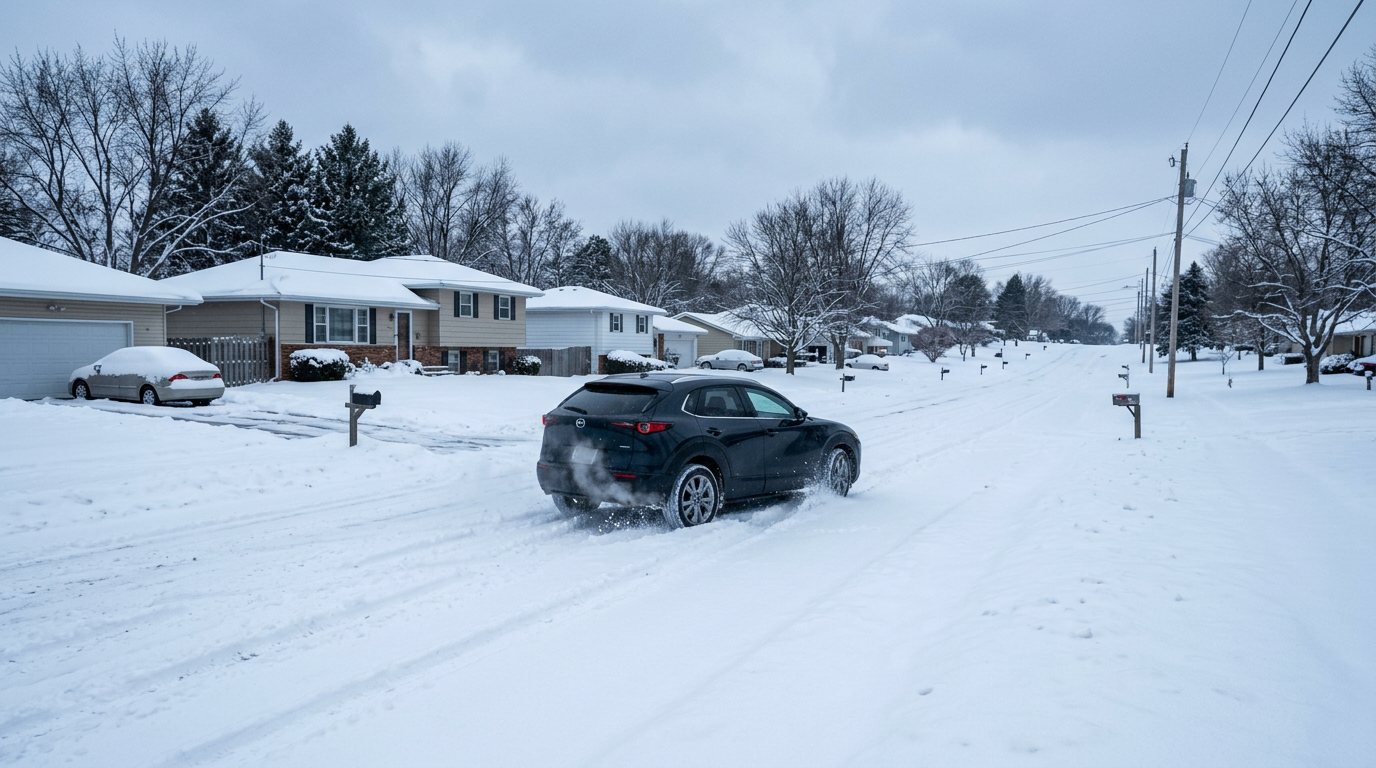
Subaru Symmetrical AWD handles deep winter snow by using a balanced, linear drivetrain layout that feeds continuous power to all four wheels simultaneously. Unlike dynamic slip-and-grip systems that wait for front-wheel slippage before engaging the rear axle, Subaru Symmetrical All-Wheel Drive maintains an active power split across both axles at all times, preventing loss of momentum before traction disappears.
The core advantage of this system lies in its mechanical symmetry and longitudinal engine alignment. By housing the boxer engine inline with the transmission along the vehicle centerline, weight is distributed evenly between the left and right sides. Equal-length driveshafts extend from the center differential to each wheel, eliminating torque steer and ensuring that steering inputs remain predictable when navigating slick surfaces. On heavy slush days near the Des Moines River valley, this continuous balance keeps vehicle control steady through changing snow depths and icy ruts.
When road conditions deteriorate from light frost to heavy packed snow, maintaining constant power transfer prevents wheels from breaking traction during initial acceleration. If one side of the vehicle hits an icy patch, power naturally flows to the wheels maintaining solid contact. Drivers seeking to inspect or upgrade their vehicle before winter weather arrives can visit our showroom at 9625 Hickman Rd in Urbandale or reach out to our service advisors by giving our team a quick call to verify their vehicle's winter readiness.
Table of Contents
- What Is the Difference Between Subaru Active Torque Split AWD and X-MODE in Snow?
- How Does Subaru Ground Clearance and X-MODE Clear Snow Drifts and Snowbanks?
- What Essential Winter Maintenance Services Prepare Your Subaru for Central Iowa Winters?
- How Do Cold Temperatures Affect Subaru Battery Life, Cold Starting, and Tire Pressure?
- How Does Proper Winter Upkeep Protect Subaru Resale Value?
- Common Questions About Preparing Your Subaru Symmetrical AWD for Winter
- Prepare Your Subaru for Winter Driving at Ramsey Subaru
What Is the Difference Between Subaru Active Torque Split AWD and X-MODE in Snow?
Subaru Active Torque Split AWD functions as the primary full-time all-wheel-drive system during standard driving, whereas X-MODE acts as a low-speed software and hardware manager that recalibrates engine response, gear ratios, and braking to extract maximum traction in extreme snow conditions.
| Feature / Characteristic | Active Torque Split AWD | X-MODE System |
|---|---|---|
| Operating Speed | Active continuous at all vehicle speeds | Low-speed focused (under 25 mph) |
| Primary Function | Continuous 60/40 front-to-rear traction | Maximum low-speed extrication & control |
| Throttle Response | Standard linear driver input | Softened to prevent wheel spin |
| Braking Intervention | Standard VDC stability intervention | Targeted individual wheel braking |
| Transmission Behavior | Standard Lineartronic CVT ratios | Locked lower ratios for higher torque |
Under normal highway and suburban driving, Active Torque Split AWD continuously routes approximately 60 percent of engine torque to the front wheels and 40 percent to the rear wheels through an electronically controlled continuously variable transfer clutch. The system constantly monitors sensors for wheel speed, steering angle, and vehicle yaw rate, adjusting the torque split in real time before slippage occurs.
In contrast, X-MODE is activated via a console switch when encountering unplowed secondary roads or steep, icy driveways. Once engaged at speeds below 25 mph, X-MODE alters five distinct vehicle operational parameters:
- Engine Throttle Mapping: Softens initial throttle input so torque builds gradually, preventing aggressive acceleration from spinning tires into ice holes.
- Transmission Gear Ratios: Forces the Lineartronic CVT to stay in lower ratio bands to maximize available wheel torque.
- AWD Coupling Force: Increases hydraulic pressure on the center transfer clutch to lock the front and rear axles more tightly together.
- Vehicle Dynamics Control (VDC): Increases sensitivity to wheel slip, applying targeted braking force to an individual spinning wheel much faster than standard traction control.
- Hill Descent Control: Automatically maintains a steady speed when descending slippery inclines without requiring constant pedal intervention.
Compared to other AWD systems that operate almost entirely in front-wheel drive until rear slippage is measured, Subaru Symmetrical AWD remains continuously engaged. For drivers evaluating new vehicles equipped with these winter features, exploring our selection of new Subaru inventory provides a closer look at models built to navigate Midwest winters.
How Does Subaru Ground Clearance and X-MODE Clear Snow Drifts and Snowbanks?
Subaru ground clearance prevents snow drifts from packing under the chassis and high-centering the vehicle, while X-MODE provides the targeted wheel-braking force needed to pull a vehicle out of deep snowbanks.
Most Subaru crossover and SUV models feature over 8 inches of standard ground clearance, with rugged variants like select Subaru models engineered to offer high ground clearance. Elevating the vehicle frame well above road level allows the undercarriage to clear unplowed snow drifts rather than acting as a snowplow. When snow packs tightly under a vehicle's belly, it lifts the tires off the pavement, causing the chassis to become high-centered. By keeping mechanical components, exhaust piping, and differential housings safely above snow lines, tires retain firm contact with the road surface beneath.
When a vehicle becomes stuck against a heavy snowbank left behind by municipal snowplows, traditional traction control systems often hinder recovery. Generic traction control detects spinning tires and immediately cuts engine throttle, reducing power right when momentum is required. X-MODE handles recovery differently:
- It maintains engine power while monitoring individual wheel speed sensors.
- When a tire loses grip on loose snow, X-MODE applies immediate hydraulic braking to that specific spinning wheel.
- This braking force redirects engine torque through the open differential to the opposing wheel on the same axle that has firm traction.
- The dual-mode variant adds specialized settings for Deep Snow / Mud, turning off standard engine torque reduction entirely to allow wheelspin when momentum is needed to churn through heavy drifts.
Shoppers searching for high-ground-clearance crossovers capable of navigating severe winter storms can browse our pre-owned vehicle lineup to compare various model years and trim configurations.
What Essential Winter Maintenance Services Prepare Your Subaru for Central Iowa Winters?
Preparing a Subaru for severe winter conditions requires inspecting five core mechanical systems: the 12V battery, engine cooling circuit, windshield clearing equipment, braking components, and underbody protective seals.
| Maintenance Component | Inspection Standard | Required Winter Specification |
|---|---|---|
| 12V Starter Battery | Cold Cranking Amps (CCA) load test | Full charge, zero terminal corrosion |
| Engine Coolant | Hydrometer freeze-point protection | Protection rated down to -30°F |
| Washer Fluid | Reservoir flush & refill | Winter formula rated to -20°F or lower |
| Wiper Blades | Rubber blade inspection | Winter-beam blades without frame gaps |
| Tire Tread Depth | Depth gauge measurement | Minimum 4/32-inch tread across tires |
Cold weather severely taxes automotive electrical and cooling circuits. Sub-zero temperatures reduce battery chemical activity while engine oil thickens, requiring significantly more amperage to turn over the crankshaft. Our technicians perform a dedicated load test to verify Cold Cranking Amps (CCA) before freezing weather sets in.
Engine coolant must maintain the proper 50/50 water-to-antifreeze ratio to prevent liquid from freezing inside the engine block or radiator core. Frozen coolant expands, which can crack engine blocks or burst radiator tanks. Additionally, wiper blades should be replaced every six months, and washer reservoirs must be filled with winter-grade fluid rated for -20 degrees Fahrenheit to prevent spray nozzles from freezing mid-commute.
Suburban winter commuting along Douglas Avenue and the I-35/80 corridor exposes vehicle underbodies to heavy road salt and chemical de-icers. Regular undercarriage washes remove salt deposits before oxidation sets in on brake lines and suspension components. Vehicle owners can easily schedule service online with our factory-trained technicians to complete a comprehensive winter multi-point inspection. For drivers considering an upgrade to a vehicle with complete service records, reviewing our certified pre-owned Subaru selection provides added peace of mind backed by factory inspection standards.
How Do Cold Temperatures Affect Subaru Battery Life, Cold Starting, and Tire Pressure?
Cold temperatures decrease 12V battery chemical efficiency by 30 to 60 percent while simultaneously dropping tire inflation pressure by approximately 1 PSI for every 10-degree Fahrenheit drop in ambient temperature.
As ambient air temperatures plunge below freezing, the internal chemical reaction within a standard lead-acid vehicle battery slows dramatically. At 0 degrees Fahrenheit, a battery retains roughly half of its normal starting power compared to its capacity at 80 degrees. At the same time, engine oil becomes viscous, creating resistance when turning over the engine. A battery that worked during mild autumn weather may fail on the first sub-zero morning.
Tire pressure dynamics are equally sensitive to seasonal temperature changes:
- Air contracts in cold weather, causing tire pressure to drop roughly 1 PSI for every 10-degree decline in outside temperature.
- A sudden 30-degree temperature drop overnight can reduce tire pressure by 3 to 4 PSI, triggering the Tire Pressure Monitoring System (TPMS) warning light.
- Operating an AWD vehicle on underinflated tires causes irregular tread wear and distorts the rolling circumference between tires.
- Because Subaru Symmetrical AWD relies on uniform wheel rotation speed, all four tires must be maintained within 2/32-inch of tread depth and inflated to the exact PSI listed on the driver's door jamb card.
If an unexpected battery failure or flat tire leaves you stranded, every new Subaru includes comprehensive roadside protection. Contacting Subaru Roadside Assistance at 1-800-261-2155 connects you to 24/7 emergency services, including battery jump-starts, flat tire replacements, and towing to authorized service centers. Drivers preparing for winter vehicle replacements or maintenance upgrades can contact our team for current pricing and information
How Does Proper Winter Upkeep Protect Subaru Resale Value?
Vehicles with documented winter maintenance typically retain up to 15% more resale value in snowy regions like Central Iowa.
In salt-belt states where heavy road salt and liquid magnesium chloride are applied to roads throughout winter, unwashed underbodies rapidly develop surface rust. Corrosion degrades brake lines, exhaust hardware, suspension arms, and body panels over time. Consistently washing the undercarriage during winter months removes salt accumulations before oxidation takes hold. Documented rust prevention and consistent maintenance records can boost trade-in values by $1,000 to $2,000 compared to neglected vehicles of the same model year.
| Maintenance Habit | Short-Term Winter Benefit | Long-Term Resale Value Impact |
|---|---|---|
| Regular Undercarriage Washing | Prevents salt & brine buildup | Stops structural body & frame corrosion |
| Tire Pressure Alignment Checks | Maintains optimal AWD traction | Prevents premature transfer clutch wear |
| Genuine OEM Replacement Parts | Restores original factory performance | Preserves full service history integrity |
| Synthetic Oil Fluid Service | Protects engine during cold starts | Maintains peak internal engine health |
Maintaining identical tire tread wear across all four wheels also safeguards internal AWD components. Mismatched tire diameters force the center transfer clutch or differential to work continuously to compensate for speed differences between axles, leading to premature fluid breakdown and mechanical wear. Replacing components with genuine factory parts maintains system integration and long-term reliability.
Vehicle owners looking to transition into a newer vehicle can easily value their trade-in online to evaluate current market demand. Those managing their own maintenance routines can order genuine Subaru parts online directly through our dealership to ensure every replacement meets original factory specifications.
Common Questions About Preparing Your Subaru Symmetrical AWD for Winter
Q: Does Subaru Symmetrical AWD require winter tires in low temperatures?
Subaru Symmetrical AWD maximizes available traction, but tire rubber compounds dictate stopping distance on ice and hard-packed snow. Standard all-season tires harden when ambient temperatures drop below 45 degrees Fahrenheit, reducing rubber flexibility and grip. Dedicated winter tires feature specialized silica compounds that remain pliable in sub-zero weather, alongside dense tread sipes that bite into ice. Equipping a Subaru with winter tires combines continuous four-wheel torque distribution with maximum rubber adhesion, significantly shortening braking distances on slick roads.
Q: How often should I check my tire pressure during severe winter weather?
Check tire inflation pressure at least bi-weekly during cold weather, and immediately following any sudden drop in ambient temperature. Because air contracts as temperatures plunge, tires lose roughly 1 PSI for every 10-degree drop in outside air temperature. Always check pressure when tires are cold—meaning the vehicle has been parked for at least three hours—using a reliable digital tire gauge. Maintaining the correct PSI specified on the driver's door pillar ensures even tire wear and protects the AWD center differential from rotational stress.
Q: Can I use X-MODE on dry pavement or at highway speeds?
X-MODE is engineered specifically for low-speed, low-traction environments and should not be used on dry pavement or at high speeds. The system automatically disengages or reverts to standard AWD mode once vehicle speed exceeds approximately 25 mph. Engaging low-speed traction modes on dry surfaces can cause driveline binding during sharp turns because tire slippage cannot occur naturally on dry asphalt. Use X-MODE exclusively when navigating deep snow, ice, mud, or steep unpaved inclines below 25 mph.
Q: Why does my Subaru engine idle higher on freezing winter mornings?
Subaru boxer engines idle at a higher RPM immediately after a cold start to warm up the catalytic converter quickly and bring engine oil up to operating temperature. This cold-start strategy ensures proper exhaust emissions reduction and speeds up heater core warm-up for cabin defrosting. Drivers should allow the initial high idle to settle naturally for 30 to 60 seconds before shifting into gear, allowing synthetic engine oil to circulate fully through the valvetrain and turbocharger bearings.
Q: Where can I get my Subaru inspected before winter weather arrives?
Drivers can get their vehicle inspected at our dedicated dealership service center located at 9625 Hickman Rd in Urbandale. Our factory-trained technicians conduct thorough multi-point checks covering battery Cold Cranking Amps, coolant freeze points, brake pad thickness, and AWD transfer clutch condition. Schedule an appointment online or contact our service desk by giving our team a quick call to confirm open appointment slots.
Prepare Your Subaru for Winter Driving at Ramsey Subaru
Ramsey Subaru offers comprehensive winter preparation services including tire checks, fluid top-offs, and underbody inspections to keep your vehicle safe. From testing battery cold-cranking capacity to verifying that Active Torque Split AWD and X-MODE systems are operating at peak performance, early seasonal preparation ensures your vehicle delivers reliable traction through severe snowstorms.
Our service team at Ramsey Subaru is equipped with specialized diagnostic tools, genuine OEM parts, and factory-trained technicians who understand the technical demands of Subaru Symmetrical All-Wheel Drive. Whether you need a winter fluid flush, a fresh set of winter tires, or a complete multi-point inspection before sub-zero temperatures arrive, our facility provides comprehensive care tailored to Midwestern driving demands. Contact our service advisors today to complete your pre-winter maintenance plan.
© 2026 Ramsey Subaru. All rights reserved.